
How to Generate More Pipeline Before, During, and After Every Event
The Secret to Successful Trade Show Appointment Setting
Trade shows have always been one of the biggest investments B2B companies make. Between booth space, travel, sponsorships, shipping, hotels, and employee time, it's not uncommon to spend tens—or even hundreds—of thousands of dollars on a single event.
Yet many companies approach trade shows with one strategy: Show up, hope the right people stop by, and follow up with badge scans afterward.
The problem is that hoping for leads isn't a sales strategy. In fact, it’s a recipe for leaving significant money on the table and killing next year’s trade show schedule for your brand.
The companies that consistently see the strongest return on investment don’t treat trade shows as a marketing event, but as an outbound sales opportunity. That's where trade show lead generation and trade show appointment setting make the difference. Instead of waiting for conversations to happen, you create them—before the event, throughout the show, and long after everyone heads home.
Here are a few best practices that can help turn your next conference into a meaningful source of qualified pipeline.
Start Booking Meetings Before You Ever Arrive
One of the biggest mistakes companies make is waiting until the trade show begins to think about prospecting. But by then, it's already too late.
The highest-performing exhibitors begin outreach four to six weeks before the event, identifying the companies and decision-makers they want to meet while calendars are still relatively open.
Your pre-show plan should include:
Building a list of target accounts attending or exhibiting
Researching decision-makers before reaching out
Launching cold email and cold calling campaigns
Scheduling meetings before travel begins
Identifying competitors and complementary vendors worth connecting with
The goal isn't to fill every hour of your calendar, but to make sure you're walking into the event with meaningful conversations already scheduled instead of hoping booth traffic fills your day. Think of the trade show as the location where meetings happen, not where prospecting starts.
Work the Floor Like a BDR
Once the event begins, many sales teams naturally stay near their booth waiting for attendees to approach. There's nothing wrong with staffing your booth, but some of the best conversations happen outside of it.
Walking the show floor creates opportunities to meet people who may never have wandered into your exhibit. The key is to keep those conversations natural. Instead of opening with a sales pitch, try something simple: "What's been the most interesting thing you've seen today?" or "How is the show going for you so far?"
These casual conversation starters feel human rather than transactional. They invite discussion instead of immediately asking someone to buy something.
Then, once the conversation starts, resist the temptation to talk about yourself. Listen first and ask questions. Understand what brought them to the conference, what challenges they're trying to solve, and what they're evaluating. The more information you gather, the more valuable your follow-up becomes.
Capture More Than Just Contact Information
Collecting business cards or scanning badges is only part of the job. The details surrounding the conversation are often what matter most.
Immediately after speaking with someone, make quick notes such as:
What problem they mentioned
Products or services they were evaluating
A personal detail they shared
Who else from their company attended
Any promised follow-up items
Many experienced event teams also snap photos of booths, signage, or products (when appropriate) to help jog their memory later. Those small details become incredibly valuable when you're following up days later with dozens or even hundreds of contacts. Without notes, every follow-up starts to sound the same. With notes, every email feels personal.
Don't Rush the Follow-Up
Most exhibitors begin sending follow-up emails the moment they land back home. Which means your prospects receive dozens of nearly identical messages all at once. Sometimes, the best way to stand out is simply to wait.
Give people a few days to settle back into their routine. They're catching up on email, returning calls, and digging out from being out of the office. A thoughtful follow-up sent later often receives far more attention than one buried among fifty other conference emails.
When you do reach out, reference your conversation specifically. Mention something they shared and include any promised resources. Then, suggest a simple next step rather than a lengthy sales pitch.
The objective with your follow-ups is to continue the conversation where it left off.
Great Events Create Pipeline, Not Just Leads
One of the biggest misconceptions about event lead generation is that success should be measured by badge scans or business cards collected. Those numbers can be misleading.
A better question is: “How much qualified pipeline did the event create?”
Strong conference lead generation focuses on conversations that move toward real opportunities, not simply collecting as many contacts as possible. Every interaction should have a clear next step, whether that's a scheduled discovery call, product demonstration, proposal, or future meeting. And ranking your leads after the event to prioritize top prospects helps yield better results with less effort.
That's how trade shows become measurable sales channels instead of expensive networking events.
Proof That the Process Works
This approach isn't theoretical.
Members of the Harbor BD team, including founder Clayton Gilvar, have used these same principles while attending major industry events including SHOT Show, RSAC, and MODEX.
At SHOT Show, consistent floor prospecting and structured follow-up resulted in approximately 50 meaningful conversations, 11 qualified follow-ups, 7 meetings booked during or immediately after the event, and several additional meetings booked in the weeks that followed. Those conversations generated roughly $300,000 to $330,000 in qualified pipeline, with approximately $100,000 in expected revenue based on historical conversion rates.
At RSAC, strategic event business development produced six to seven strong opportunities, creating approximately $75,000 in active pipeline with significantly more potential as additional conversations progressed.
During MODEX, Harbor BD representatives logged 86 conversations, identified 14 qualified opportunities, booked six meetings, and generated approximately $300,000 in additional pipeline through conversations that happened throughout the show floor.
While every event—and every industry—is different, the pattern remains consistent: Companies that proactively create conversations before, during, and after an event consistently generate stronger outcomes than those relying solely on booth traffic.
A New Approach to Trade Show Business Development
As more companies look for ways to maximize the return on their event investment, trade show outbound services have become an increasingly important part of the sales process.
Recognizing that need, Harbor BD recently expanded its services to include Trade Show Business Development, including event lead generation services and trade show appointment setting.
The service supports companies through every phase of an event, from pre-show outreach and meeting scheduling to onsite BDR support and structured post-show follow-up, helping businesses generate measurable pipeline rather than simply collecting leads.
The philosophy is that most companies treat trade shows as marketing events. Harbor BD believes they should function as outbound sales opportunities. Because when you create conversations instead of waiting for them, every trade show has the potential to become one of your strongest pipeline-building opportunities of the year.
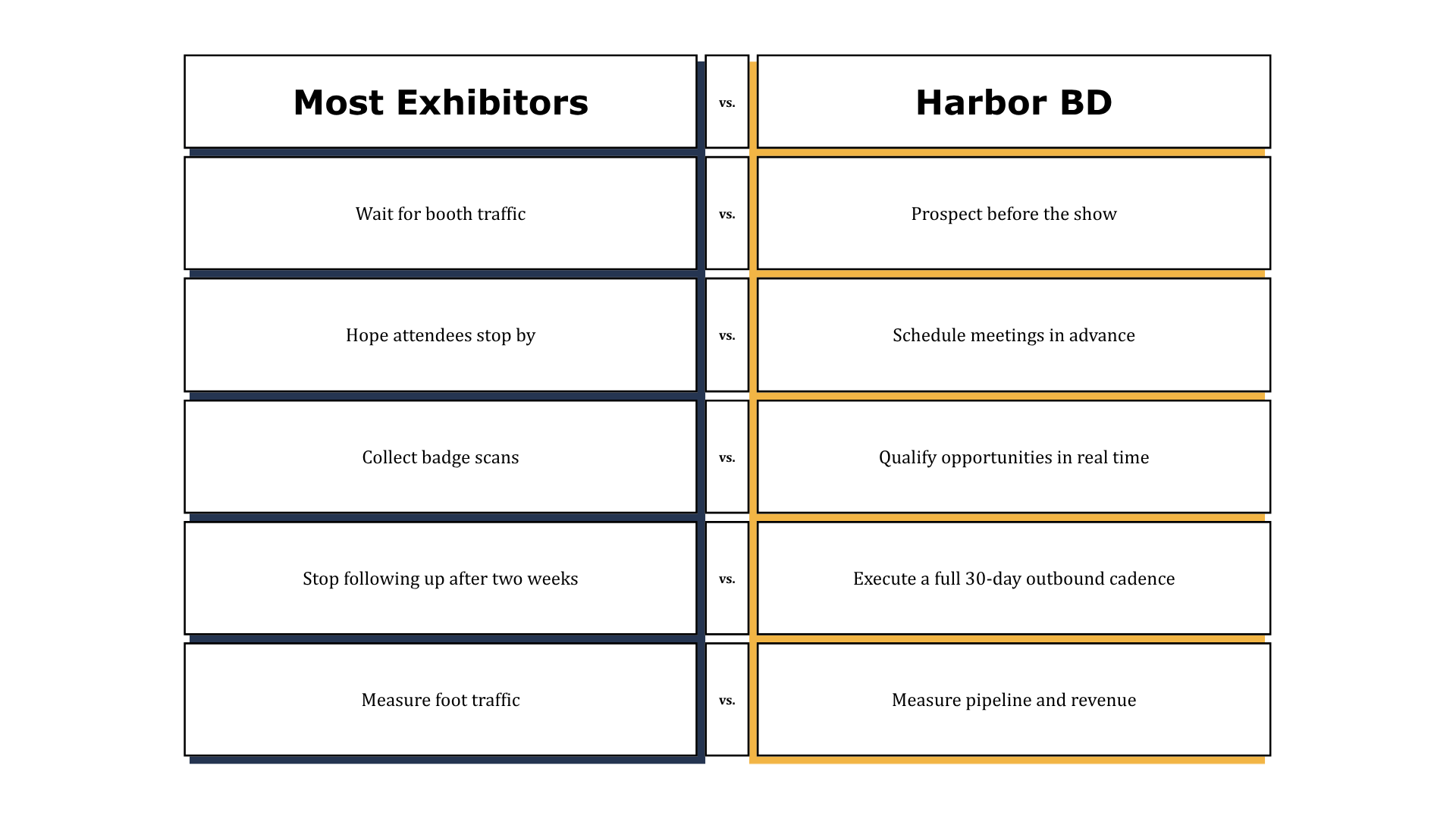
Most companies treat trade shows as marketing events.
We treat them as outbound sales opportunities.
Ready to Maximize Your Next Trade Show?
Whether you're exhibiting, attending without a booth, or looking for additional sales coverage during a busy event season, developing a structured trade show business development strategy can dramatically improve event ROI. Harbor BD offers trade show lead generation and appointment setting services designed to help companies build qualified pipeline before, during, and after every event. Explore Harbor BD’s Trade Show Outbound Services package or contact us to learn more.